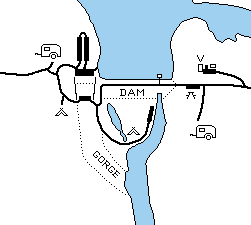
Devonian Fossil Gorge is the result of the prolonged overflow of the Coralville Reservoir Spillway between July 5 and August 2, 1993 and again between June 10 and 24, 2008. This area is just south of the Coralville Dam, managed by the Army Corps of Engineers.
To reach the Devonian Fossil Gorge, drive north out of Iowa City on North Dubuque Street and then turn right on West Overlook Road; this will take you to the west end of the Coralville Dam; at this point, turn downhill to the right, twice, and park on the paved bottom of the spillway.
Devonian Fossil Gorge was originally created by the flood of 1993, during which the water level behind the dam rose to over 4.5 feet above the crest of the spillway and poured over in a torrent, tearing away vegetation, pavement, topsoil, sedement, and loosely cemented bedrock from the area downhill from the paved spillway apron and even tearing into the solid limestone bedrock in some places. Fifteen years later, in 2008, an even larger flood drove waters almost 5 feet above the spillway, tearing away a layer of bedrock and significantly widening the gorge.
The volume of water flowing through this gorge was about 20,000 cubic feet per second at its peak in 2008, 5 or 6 times the normal summer flow of the Iowa River, and it was moving downhill at high speed. The power of the water was immense, picking up and moving blocks of stone weighing many tons. During the end of the last ice age, 10,000 years ago, the normal summer flow of the Iowa River was probably much larger. At that time, a large fraction of the water from the melting Des Moines Lobe glacier surged through the Iowa River valley, carving a deep narrow valley into the bedrock of the Iowa City area and depositing thick layers of silt in the broad flat valley to the south.
Most of Iowa's bedrock exposures are on cliff faces, either the natural walls of valleys or manmade cliffs in quarries and roadcuts. Devonian Fossil Gorge, on the other hand, is a horizontal exposure, where large areas of single rock layers are exposed. Today, this desolate expanse of exposed rock provides a fascinating look into Central Iowa's geologic past. If you look carefully, you will find numerous fossils embedded in the rock surface, ranging from coral heads to crinoids and brachiopods.
The most spectacular corals are genus hexagonaria; these have polyps about half an inch across packed into hexagonal arrays over the curved upper surface of each coral head. Coral heads can be close to a foot across. There are also solitary or horn corals. Fossil crinoids, or sea lillies (a type of animal, despite the name), are also common. The most common crinoid fossils in Devonian Fossil Gorge are fragments of the crinoid stem. These look like sticks or like stacks of flat washers. A few large stems have been exposed that are around half an inch in diameter and over a foot long. Fossils of the crinoid head (the blossom of the lilly) are rarer. Brachiopod fossils resemble clam shells, although they are not related; they are moderately common in Devonian Fossil Gorge. The final category of fossil that you will likely see is one you may not recognize as a fossil, bryozoa. The calcium carbonate skeletons of bryozoa colonies are common in the rocks of the gorge. They frequently resemble fine mesh patterns draped over the surface.
It is also worth looking for solution features in the rock; these are particularly numerous down near the river; none qualify as full-scale caves, but there are numerous pipes, some as large as a foot in diameter, that were dissolved out of the limestone by the action of slightly acidic groundwater before the surface was exposed by the flood. Where the flood has ripped away the top of one of these pipes, the exposed limestone surface has been chemically weathered, bringing fossils into sharp relief that would be harder to see if they were exposed by simple fracturing of the rock.
While visiting this area, stop at the visitor's center up on the hill across the top of the dam from the gorge. The center has a display of fossils found in the gorge, as well as some impressive video footage of the flood of '93.
It can also be fun to visit the tailwaters of the dam, particularly during the spring high water. Even when the outflow of the dam is only modest, the turbulence in the tailwaters illustrates the immense power of moving water, and during times of high water, the flow can be spectacular.
The exposed limestone of Devonian Fossil Gorge can get quite hot on a midsummer day. Visit in the spring or fall when there is good light and it isn't too hot, or visit on an early summer morning, before things get too warm.
Devonian Fossil Gorge is a transient feature of our landscape. The limestone surface exposed here was protected from the elements by a layer of sediment, and now that it is exposed to the elements, the rock will begin to weather. Freezing and cooling will flake the rock surface, acid rain will blunt the sharper features, and vegitation will find footholds in cracks in the rock.
These natural processes are unavoidable; they apply to any exposed limestone surface. A more serious problem is the damage caused by thousands of visitors. While it might be tempting to chip out a nice fossil to add to your collection, please don't collect specimins from the gorge! It is illegal to take fossils from federal land without a permit.
In the fifteen years after the flood of 1993, weathering, plant growth and foot traffic obliterated many of the fossils exposed in that first flood. With the flood of 2008, it is fair to say that the gorge has been renewed and considerably improved.
Devonian Fossil Gorge is managed by the United States Army Corps of Engineers, The park manager may be reached at (319)338-3543; the Rock Island District Office may be reached at (309)794-4200.
The official Corps of Engineers web site for the gorge is:
http://www.mvr.usace.army.mil/coralville/devonian_fossil_gorge.htm
The Iowa Geological Survey web page on the gorge is:
http://www.igsb.uiowa.edu/browse/spillway/spillway.htm